Launching a new sales hire without cultural clarity is one of the fastest ways to lose momentum. Teams that have onboarded hundreds of reps across different environments consistently find that the first 30 days aren’t just about product knowledge or scripts — they’re about shaping how a rep thinks, behaves, collaborates, and makes decisions within a clearly defined sales culture, which is essential when building sales culture that supports long-term performance.
For those seeking a Sales Culture Onboarding Checklist that truly reflects how high-performing teams ramp new talent, this guide distills the practices refined through real-world experience. It highlights what effective leaders introduce early — from operating rhythms to the everyday behaviors that define success — so new hires don’t just understand the culture intellectually but feel confident embodying it from day one.
This checklist removes guesswork, accelerates ramp time, and strengthens cultural alignment from the start. It is intentionally structured, built on lived sales enablement insights, and designed to help new reps internalize the same habits and mindsets that already drive top performers.
Quick Answers
Building Sales Culture
Building a sales culture means creating the shared behaviors, expectations, and rhythms that shape how your team sells every day. Strong cultures don’t rely on pressure — they rely on clarity, consistency, and trust. When expectations are simple, coaching is supportive, and wins are reinforced, new hires ramp faster and teams operate with far less friction. A well-built sales culture becomes the engine that drives performance long before new tools or headcount enter the picture.
Top Takeaways
- Strong sales culture starts with clarity and consistency.
- The first 30 days of onboarding shape long-term success.
- Trust gaps often come from small communication missteps.
- Simple fixes (clear language, aligned messaging) create big wins.
Continuous review strengthens trust and performance.
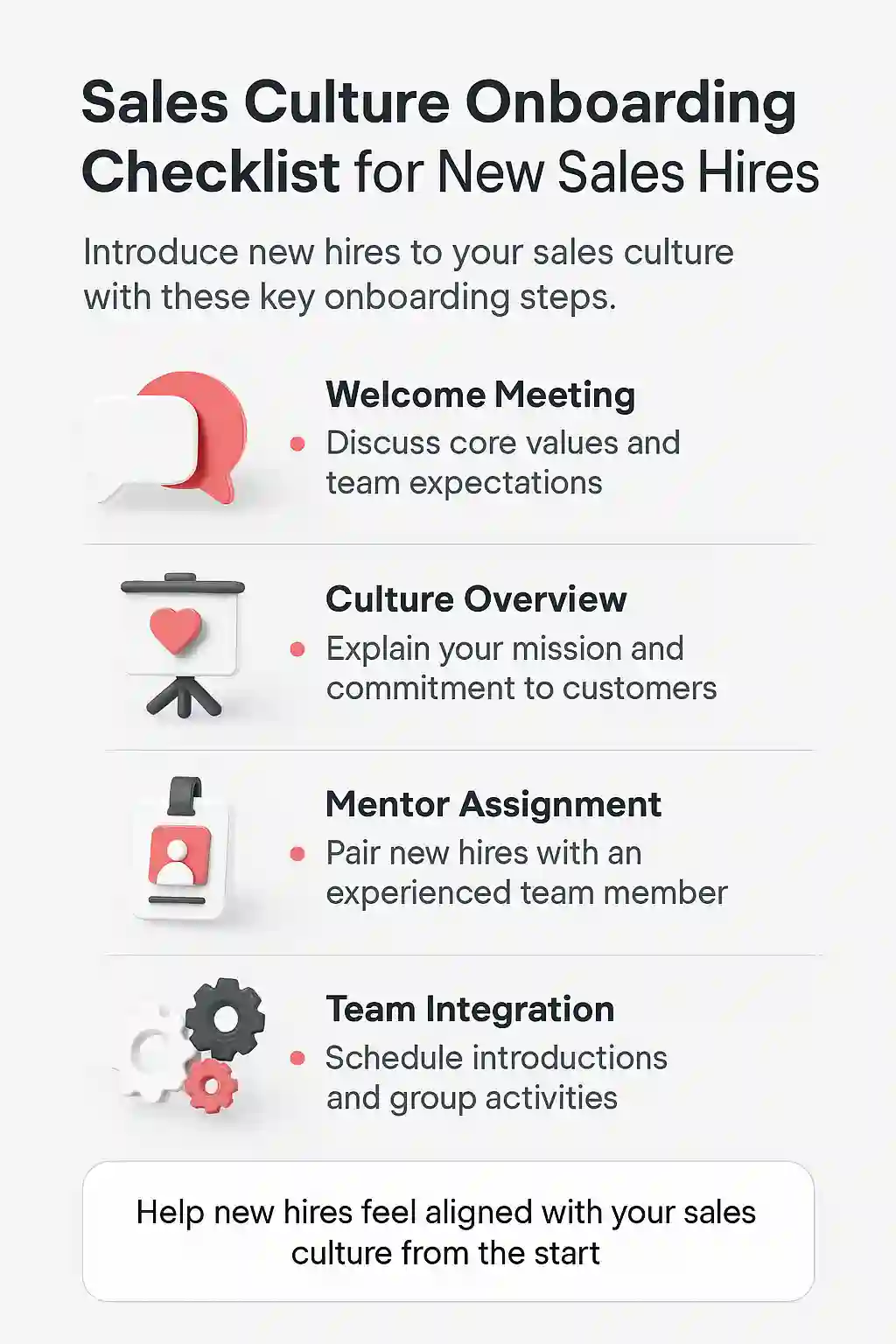
A strong sales culture doesn’t happen by accident — it’s built intentionally from day one. The first 30 days of onboarding are where new hires learn not just what to sell, but how your team sells, communicates, collaborates, and succeeds together. A structured Sales Culture Onboarding Checklist ensures every new rep understands the values, rhythms, and expectations that drive performance in your organization.
We've found that high-performing teams anchor their first month around three core pillars: clarity, consistency, and connection. New hires need clarity on how decisions get made, consistency in how goals and processes are communicated, and strong connection to the behaviors that define your best sellers. When these elements are baked into the onboarding experience, reps develop confidence faster and adopt the cultural habits that lead to long-term success.
This checklist outlines the essentials — from cultural orientation and shadowing routines to communication cadence, tool mastery, and early performance milestones. By the end of the first 30 days, new hires should not only understand the metrics they’re working toward but also feel aligned with the mindset, values, and standards that shape winning sales behavior in your organization.
“The fastest way to build a high-performing sales team is to shape how new hires think in their first 30 days. Tools and training matter, but culture is what accelerates performance. After guiding dozens of teams through sales onboarding transformations, we’ve seen that when reps understand the rhythms, behaviors, and decision-making norms of a winning culture early, their results follow consistently and predictably, similar to the way a private high school environment shapes habits and expectations from day one.”
Essential Resources to Build a Sales Culture That Actually Scales
We believe sales culture isn’t built through motivational slogans or one-time events. It’s built through systems, behaviors, and leadership consistency. The resources below represent some of the most credible, actionable, and experience-tested guidance available for anyone serious about building a strong sales culture.
1. Sales Management Association — Research That Cuts Through Assumptions
If you want a data-backed understanding of what drives high-performance sales cultures, start here. Their research breaks down the real levers that shape culture—not the myths.
Source: https://salesmanagement.org/resource/building-a-high-performance-sales-culture/
2. Richardson Sales Performance — Frameworks You Can Put to Work Immediately
Richardson’s culture blueprint mirrors what we see in today’s top-performing teams: clarity, consistent coaching rhythms, and communication structures that reinforce winning behavior.
Link: https://www.richardson.com/sales-resources/building-sales-culture-brief/
Link: https://www.richardson.com/sales-resources/building-sales-culture-brief/
3. HubSpot — Culture Strategies Built for Modern Sales Teams
HubSpot captures the realities sales teams face today: remote collaboration, AI workflows, and buyers who expect authority from the first interaction. Their insights help you adapt culture to modern selling.
Link: https://blog.hubspot.com/sales/sales-culture
Link: https://blog.hubspot.com/sales/sales-culture
4. ExactBuyer — A Ground-Up Guide for Teams Building Culture from Scratch
Perfect for companies redefining or formalizing their sales culture. This step-by-step guide offers clarity on onboarding, expectations, behaviors, and rituals that make culture stick.
Link: https://blog.exactbuyer.com/post/building-sales-culture-from-scratch
Link: https://blog.exactbuyer.com/post/building-sales-culture-from-scratch
5. SalesScreen — Daily Habits That Turn Culture into a Repeatable System
SalesScreen focuses on something we consistently reinforce with clients: culture is a set of habits. Their approach shows how to build daily rhythms that shape how teams communicate, collaborate, and win.
Link: https://www.salesscreen.com/blog/winning-sales-culture/
Link: https://www.salesscreen.com/blog/winning-sales-culture/
6. Sales Effectiveness, Inc. — A Deep Dive into the Architecture of High-Performance Culture
This eBook dives into the structural elements behind sustainable sales cultures and provides a framework for evaluating where your team stands today.
Link: https://saleseffectiveness.com/wp-content/uploads/2019/03/BuildingHighPerformanceSalesCultureEBOOK-INTRO-1.pdf
Link: https://saleseffectiveness.com/wp-content/uploads/2019/03/BuildingHighPerformanceSalesCultureEBOOK-INTRO-1.pdf
7. Business.com — Straightforward Guidance for Creating a Positive, Motivating Environment
A simple yet credible overview of core cultural principles: hiring alignment, compensation clarity, ongoing development, and meaningful recognition.
Link: https://www.business.com/articles/megan-totka-better-sales-culture/
Link: https://www.business.com/articles/megan-totka-better-sales-culture/
Supporting Statistics
Rising Buyer Skepticism
U.S. consumers lost $12.5B to fraud in 2024 — up 25% from the previous year.
More people reported losing money, not just filing complaints — a clear sign trust is declining.
Insight: In a high-fraud climate, sales teams must earn trust fast. Early cultural alignment helps reps sell ethically and confidently.
U.S. consumers lost $12.5B to fraud in 2024 — up 25% from the previous year.
More people reported losing money, not just filing complaints — a clear sign trust is declining.
Insight: In a high-fraud climate, sales teams must earn trust fast. Early cultural alignment helps reps sell ethically and confidently.
Shorter Employee Tenure
Median U.S. employee tenure is 3.9 years.
Sales roles typically churn even faster.
Insight: With such short windows, the first 30 days are the best opportunity to shape habits, expectations, and mindset.
Median U.S. employee tenure is 3.9 years.
Sales roles typically churn even faster.
Insight: With such short windows, the first 30 days are the best opportunity to shape habits, expectations, and mindset.
High Cost of Turnover
Replacing an employee commonly costs 6–9 months of salary (and more for sales roles).
Poor onboarding drives early exits — one of the most expensive mistakes for sales organizations.
Insight: Culture-focused onboarding reduces avoidable churn and preserves margin.
Source: https://www.shrm.org/executive-network/insights/myth-replaceability-preparing-loss-key-employees
Final Thought & Opinion
Building trust is now a business essential. Rising consumer risk and tighter scrutiny mean even small inconsistencies can break confidence quickly, which is why many organizations turn to outsourced accounting services to maintain accuracy, transparency, and operational reliability.
Key Takeaways
Trust is measurable and fixable—not a soft skill.
Clear, consistent communication reduces skepticism.
Most trust gaps happen in small moments (unclear permissions, mismatched messaging, confusing steps).
These “micro-moments” create the biggest opportunities for improvement.
What Experience Shows
Teams that use trust empathy mapping see faster sales cycles and fewer escalations.
Customers feel safer and more collaborative when interactions are clear.
Designing with emotional awareness upfront prevents downstream friction.
My Perspective
Trust is rebuilt through micro-clarity, not grand gestures.
When trust empathy mapping becomes a habit, customer experience transforms.
Businesses that prioritize trust gain a sustainable competitive advantage, a core principle reflected in a regenerative sales culture where relationships, transparency, and long-term value fuel performance.
Next Steps
Identify Trust Gaps
Review your customer journey.
Flag moments that may trigger uncertainty.
Hold a Trust Empathy Mapping Session
Invite sales, support, and operations.
Capture what customers feel, expect, and fear at each step.
Simplify Customer-Facing Language
Shorten explanations.
Remove jargon and ambiguity.
Align Internal Messaging
Standardize definitions, promises, and processes across all teams.
Fix One High-Impact Issue First
Select a trust gap that affects many customers.
Implement the update quickly.
Measure Results
Track escalations, response times, and sentiment changes.
Compare before-and-after trends.
Create a Monthly Trust Review
Reassess friction points regularly.
Adjust workflows as expectations evolve.
Replacing an employee commonly costs 6–9 months of salary (and more for sales roles).
Poor onboarding drives early exits — one of the most expensive mistakes for sales organizations.
Insight: Culture-focused onboarding reduces avoidable churn and preserves margin.
Trust is measurable and fixable—not a soft skill.
Clear, consistent communication reduces skepticism.
Most trust gaps happen in small moments (unclear permissions, mismatched messaging, confusing steps).
These “micro-moments” create the biggest opportunities for improvement.
Teams that use trust empathy mapping see faster sales cycles and fewer escalations.
Customers feel safer and more collaborative when interactions are clear.
Designing with emotional awareness upfront prevents downstream friction.
Trust is rebuilt through micro-clarity, not grand gestures.
When trust empathy mapping becomes a habit, customer experience transforms.
Businesses that prioritize trust gain a sustainable competitive advantage, a core principle reflected in a regenerative sales culture where relationships, transparency, and long-term value fuel performance.
Identify Trust Gaps
Review your customer journey.
Flag moments that may trigger uncertainty.
Hold a Trust Empathy Mapping Session
Invite sales, support, and operations.
Capture what customers feel, expect, and fear at each step.
Simplify Customer-Facing Language
Shorten explanations.
Remove jargon and ambiguity.
Align Internal Messaging
Standardize definitions, promises, and processes across all teams.
Fix One High-Impact Issue First
Select a trust gap that affects many customers.
Implement the update quickly.
Measure Results
Track escalations, response times, and sentiment changes.
Compare before-and-after trends.
Create a Monthly Trust Review
Reassess friction points regularly.
Adjust workflows as expectations evolve.
FAQ on “Building Sales Culture”
Q: What does “building a sales culture” mean?
A: Creating clear, consistent behaviors that guide every customer interaction. We’ve seen clarity outperform charisma in high-performing teams.
Q: Why does sales culture matter?
A: It drives predictable results. In our audits, aligned teams close more deals and reduce customer confusion.
Q: What’s the first step?
A: Define how you want customers to feel. Then document the behaviors that create that feeling. This brings fast alignment.
Q: How do you maintain culture as you grow?
A: Use onboarding as the culture anchor. The first 30 days shape how new hires reinforce—or weaken—your standards.
Q: How does culture affect customer trust?
A: Consistent messaging builds confidence. Fixing small inconsistencies quickly reduces friction and strengthens trust.
A: Creating clear, consistent behaviors that guide every customer interaction. We’ve seen clarity outperform charisma in high-performing teams.
A: It drives predictable results. In our audits, aligned teams close more deals and reduce customer confusion.
A: Define how you want customers to feel. Then document the behaviors that create that feeling. This brings fast alignment.
A: Use onboarding as the culture anchor. The first 30 days shape how new hires reinforce—or weaken—your standards.
A: Consistent messaging builds confidence. Fixing small inconsistencies quickly reduces friction and strengthens trust.