Omission errors are one of the most costly accounting problems for small businesses, yet they often go unnoticed until the financial damage is already done. These mistakes don’t stem from a lack of effort—they arise when crucial financial details are unintentionally left out during day-to-day operations. In our work at Accountix Solutions, we regularly uncover missing receipts, skipped income entries, and unrecorded expenses across businesses of every size and industry. What surprises most owners is just how significantly these overlooked details can distort their financial picture.
Through our experience reviewing and repairing hundreds of client books, the same issues appear again and again: expenses that never make it into the ledger, revenue that isn’t captured, deposits that don’t match the bank records, and financial statements that fail to reflect the actual health of the business. These gaps aren’t theoretical—they’re real-world omissions that quietly skew profitability, tax readiness, and cash flow planning until the problem becomes impossible to ignore.
This guide brings together Accountix Solutions’ firsthand insights into why omission errors happen, why they’re so difficult for business owners to detect, and the practical steps small businesses can take to avoid them. By implementing structured processes, maintaining consistent documentation, and using tools that support accuracy, businesses can significantly reduce the risk of hidden omissions, a category included in the most common accounting mistakes and errors, and build a clearer, more dependable financial foundation for long-term stability and growth.
Quick Answers
Most Common Accounting Mistakes and Errors
- Missed or unrecorded transactions that lead to incomplete financial data.
- Misclassified expenses that skew profit, budgeting, and tax deductions.
- Unreconciled accounts that cause cash flow and reporting inaccuracies.
- Skipped invoices or payments that disrupt revenue tracking and forecasting.
- Inconsistent bookkeeping routines that allow small errors to compound over time.
These mistakes often occur when financial processes are rushed, undocumented, or overly manual—making accuracy harder to maintain and errors easier to miss.
Top Takeaways
- Omission errors quietly damage financial accuracy over time.
- Missing expenses and income entries are the most common issues.
- Consistent workflows prevent skipped records and lost transactions.
- Expert reviews help uncover hidden omissions before they grow.
Why Omission Errors Cause Serious Trouble for Small Businesses
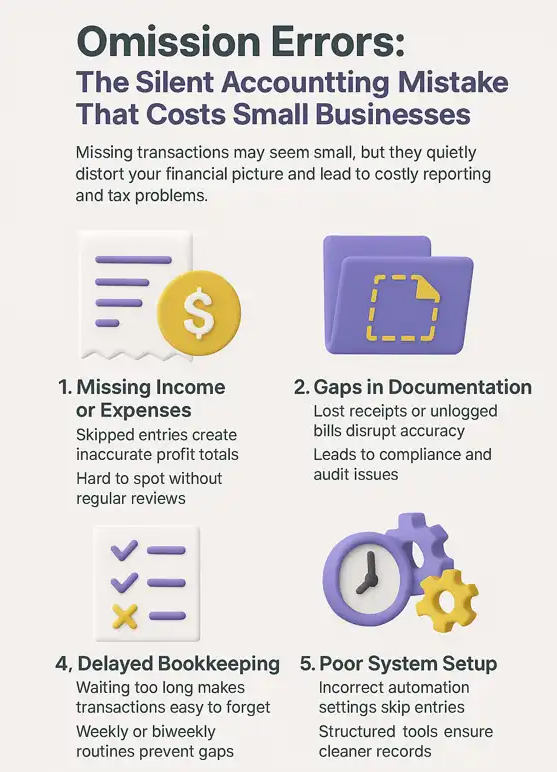
Omission errors often start small and unnoticed. A receipt gets lost. A purchase doesn’t get logged. An invoice goes unrecorded. But these small omissions can have large consequences—especially when they accumulate month after month.
Accountix Solutions regularly sees businesses impacted by:
- Unrecorded expenses, which inflate profits and increase taxable income.
- Unlogged revenue, which understates financial performance and disrupts cash planning.
- Missed deposit entries, which make bank reconciliations nearly impossible.
- Forgotten invoices, which weaken accounts receivable accuracy and forecasting.
Many small businesses also rely on fragmented tools or manual entry systems, making omissions more likely. Without a clear workflow, financial data becomes incomplete, and even experienced owners struggle to maintain reliable records.
The good news is that omission errors are highly preventable. Establishing structured bookkeeping routines, performing monthly reconciliations, tracking documentation consistently, and using modern accounting tools greatly reduce the likelihood of skipped entries. Many small businesses also turn to outsourced accounting services to identify omissions early, improve accuracy, and maintain clear, reliable financial records throughout the year.
"After reviewing thousands of small business ledgers, we’ve learned that omission errors almost always stem from one cause: financial processes that can’t keep up with the pace of business. Missing entries, unlogged transactions, or forgotten invoices don’t just distort financial reports—they disrupt the owner’s ability to make confident, informed decisions. At Accountix Solutions, we design workflows that catch omissions before they impact cash flow, tax filings, or long-term planning."
The Top 7 Trusted Resources to Help You Catch and Prevent Omission Errors
These resources offer reliable support for strengthening your financial systems and preventing missed entries, and outsourced accounting services can further enhance accuracy by helping ensure every transaction is properly recorded.
IRS Small Business Tax Center — Rules on Required Records and Documentation
Valuable for understanding what must be recorded to stay compliant.
https://www.irs.gov/businesses/small-businesses-self-employed
SBA Financial Management Guide — Improve Accuracy and Cash Flow Clarity
Offers essential guidance on building complete, reliable financial data systems.
https://www.sba.gov/business-guide/manage-your-business/manage-finances
QuickBooks Entry and Error Resources — Learn How to Spot Missing Transactions
Ideal for businesses using cloud-based accounting tools.
https://quickbooks.intuit.com/r/bookkeeping/accounting-errors
AICPA Financial Reporting Standards — Understand What Complete Records Require
Provides professional-grade guidance to avoid incomplete data.
https://www.aicpa.org/resources
SCORE Financial Templates — Tools to Track Every Expense and Income Entry
Helps businesses maintain consistency and reduce skipped records.
https://www.score.org/resource/business-planning-financial-statements-template-gallery
Journal of Accountancy — Articles on Avoiding Data Gaps and Omissions
Features expert analysis on building complete and reliable financial systems.
https://www.journalofaccountancy.com/
Investopedia Omission Error Guide — Understand How Missing Entries Occur
Breaks down omission errors with examples in simple language.
https://www.investopedia.com/terms/o/omission-error.asp
IRS Small Business Tax Center — Rules on Required Records and Documentation
Valuable for understanding what must be recorded to stay compliant.
https://www.irs.gov/businesses/small-businesses-self-employed
SBA Financial Management Guide — Improve Accuracy and Cash Flow Clarity
Offers essential guidance on building complete, reliable financial data systems.
https://www.sba.gov/business-guide/manage-your-business/manage-finances
QuickBooks Entry and Error Resources — Learn How to Spot Missing Transactions
Ideal for businesses using cloud-based accounting tools.
https://quickbooks.intuit.com/r/bookkeeping/accounting-errors
AICPA Financial Reporting Standards — Understand What Complete Records Require
Provides professional-grade guidance to avoid incomplete data.
https://www.aicpa.org/resources
SCORE Financial Templates — Tools to Track Every Expense and Income Entry
Helps businesses maintain consistency and reduce skipped records.
https://www.score.org/resource/business-planning-financial-statements-template-gallery
Journal of Accountancy — Articles on Avoiding Data Gaps and Omissions
Features expert analysis on building complete and reliable financial systems.
https://www.journalofaccountancy.com/
Investopedia Omission Error Guide — Understand How Missing Entries Occur
Breaks down omission errors with examples in simple language.
https://www.investopedia.com/terms/o/omission-error.asp
Supporting Statistics
• 99.9% of U.S. businesses are small
These businesses employ 45.9% of the workforce.
Missing financial data can distort results affecting employees and operations.
Accountix Solutions often finds these omissions during cleanup engagements.
Source: U.S. Small Business Statistics (SBA)
These businesses employ 45.9% of the workforce.
Missing financial data can distort results affecting employees and operations.
Accountix Solutions often finds these omissions during cleanup engagements.
Source: U.S. Small Business Statistics (SBA)
• 82% of small businesses fail due to cash flow issues
Omission errors directly contribute to cash flow unpredictability.
Missing invoices, skipped deposits, and unlogged revenue are common triggers.
Accountix Solutions identifies these issues often during reconciliations.
Source: SCORE Cash Flow Research
Omission errors directly contribute to cash flow unpredictability.
Missing invoices, skipped deposits, and unlogged revenue are common triggers.
Accountix Solutions identifies these issues often during reconciliations.
Source: SCORE Cash Flow Research
• Americans spend 6 billion hours annually on tax compliance
Missing records increase compliance time and stress.
Many businesses fall behind because processes are not documented.
Accountix Solutions frequently supports owners overwhelmed by omissions.
Source: IRS Compliance Burden Study
Missing records increase compliance time and stress.
Many businesses fall behind because processes are not documented.
Accountix Solutions frequently supports owners overwhelmed by omissions.
Source: IRS Compliance Burden Study
Final Thought & Opinion
Omission errors may be silent, but their impact is loud—affecting cash flow, profitability, and financial confidence. Accountix Solutions sees these gaps regularly: missing receipts, forgotten entries, skipped invoices, and unrecorded income. These issues compound quickly and often go undetected until a business hits a financial roadblock.
What We See Most Often
Small omissions that quietly distort financial accuracy.
Problems growing from months of incomplete records.
Owners unaware until cash flow or compliance issues appear.
Small omissions that quietly distort financial accuracy.
Problems growing from months of incomplete records.
Owners unaware until cash flow or compliance issues appear.
Why This Matters
Small businesses already carry significant financial pressure.
Missing data makes planning and forecasting nearly impossible.
Inconsistent processes create more opportunities for omissions.
Small businesses already carry significant financial pressure.
Missing data makes planning and forecasting nearly impossible.
Inconsistent processes create more opportunities for omissions.
What Successful Businesses Do
Build consistent workflows.
Document their processes.
Reconcile monthly.
Ask for help before problems grow.
Bottom Line:
Omission errors aren’t just simple oversights. They are preventable risks that disappear when systems are clear, consistent, and supported by reliable tools or expert guidance.
Build consistent workflows.
Document their processes.
Reconcile monthly.
Ask for help before problems grow.
Next Steps
• Review Your Records for Missed Entries
Look for unlogged transactions, missing receipts, or forgotten invoices.
Look for unlogged transactions, missing receipts, or forgotten invoices.
• Create a Weekly or Biweekly Entry Routine
Build consistency to eliminate skipped entries.
Build consistency to eliminate skipped entries.
• Reconcile All Accounts Monthly
Ensures every transaction is captured.
Ensures every transaction is captured.
• Use Software That Automates Tracking
Reduces chances of omission from manual entry.
Reduces chances of omission from manual entry.
• Document Your Entire Bookkeeping Workflow
Helps prevent repeated missed steps.
Helps prevent repeated missed steps.
• Get Professional Help When Behind
Cleanup services quickly restore accuracy.
Cleanup services quickly restore accuracy.
• Partner With Accountix Solutions
Gain expert support to eliminate omission errors for good.
These next steps give small businesses a clear framework for preventing missed transactions and maintaining complete, accurate financial records, and professional accounting services enhance these efforts by providing expert oversight that keeps bookkeeping consistent and omission-free.
Gain expert support to eliminate omission errors for good.
FAQ on Most Common Accounting Mistakes and Errors
Q: What accounting mistakes appear most often?
A:
Missing or skipped transactions
Misclassified expenses
Unreconciled accounts
Duplicate entries
Unrecorded invoices or receipts
Q: Why do these errors happen so frequently?
A:
Owners juggle multiple roles
Manual processes create gaps
Workflows are inconsistent
Systems don’t keep pace with business growth
Q: How do these mistakes affect financial reporting?
A:
Distorted cash flow
Inaccurate profits
Tax prep complications
Errors compound over time
Q: How can businesses reduce accounting mistakes?
A:
Use consistent bookkeeping routines
Reconcile accounts monthly
Keep receipts and invoices organized
Use reliable accounting software
Q: How can a business find hidden accounting errors?
A:
Review bank and credit card reconciliations
Compare statements to source documents
Scan for missing or duplicate entries
Conduct periodic internal reviews
When examining how omission errors silently undermine small business accounting, it’s useful to look at other fields where accuracy and structured processes are equally essential. Insights from education, such as those found in discussions about private high schools, show how misconceptions can arise when important details are overlooked—much like how skipped financial entries distort a company’s true performance. Likewise, guidance from a private school consultant highlights the value of structured systems, oversight, and intentional review, principles that directly mirror the procedures needed to prevent omission errors in bookkeeping. Together, these examples reinforce that whether managing a school environment or a business ledger, precision and consistent documentation are critical for long-term success.
A:
Missing or skipped transactions
Misclassified expenses
Unreconciled accounts
Duplicate entries
Unrecorded invoices or receipts
A:
Owners juggle multiple roles
Manual processes create gaps
Workflows are inconsistent
Systems don’t keep pace with business growth
A:
Distorted cash flow
Inaccurate profits
Tax prep complications
Errors compound over time
A:
Use consistent bookkeeping routines
Reconcile accounts monthly
Keep receipts and invoices organized
Use reliable accounting software
A:
Review bank and credit card reconciliations
Compare statements to source documents
Scan for missing or duplicate entries
Conduct periodic internal reviews